Before the Alarm Clock: How People Marked the Start of Morning
Morning cues before alarm clocks ranged from daylight to household tasks. See how a useful signal marked a change without setting one universal schedule.
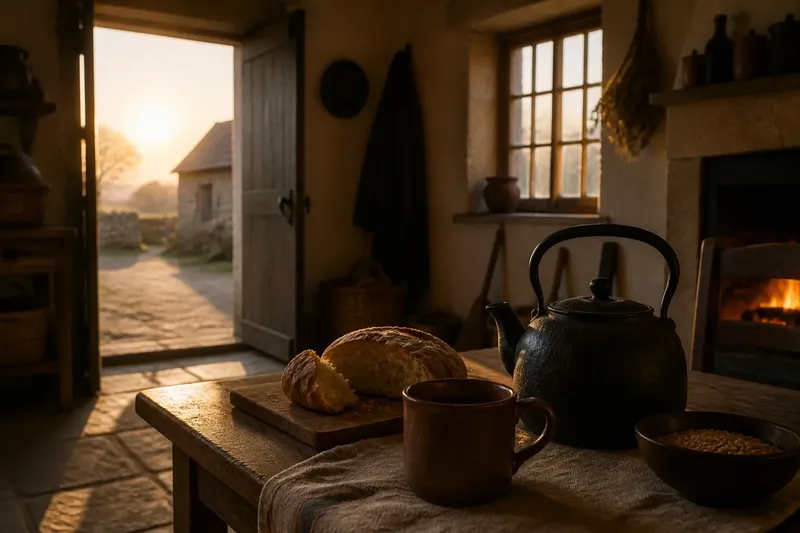
A pale strip of daylight reaches the kitchen floor while the house is still quiet. Before alarm clocks became household tools, people often recognized morning through visible light, familiar sounds, and the first duties of the day. These cues marked a transition, though they did not set one start time for everyone.
Morning cues before clocks
Daylight offered a broad sign that night was giving way, but it was not a precise appointment. Dawn shifts with the seasons, and hills, buildings, clouds, and local surroundings affect when a person can see it.
For outdoor tasks, a practical start might be the moment there was enough light to follow a path, tend animals, or work in a field. Someone indoors or in a shaded street could experience that transition differently from a neighbor watching the eastern sky.
Darkness did not necessarily mean that all activity stopped. Household work, travel, religious observance, and other duties could happen at night. In that context, morning might mean returning daylight, the start of a particular task, or the moment a household became active.
Signals beyond the household
In some communities, bells and other public calls marked events that people were expected to recognize, such as a religious service or a civic gathering. The exact use depended on local custom; a bell’s meaning was not universal. Unlike a view of the horizon, a sound could reach people who were indoors or out of sight of one another.
Watchmen’s calls, horns, drums, or spoken announcements could also alert a group to a change in activity. Their meaning relied on shared understanding: listeners needed to know what a particular signal meant and whether it applied to them.
Sound had limits. Distance, walls, wind, and competing noise could make a call hard to hear, while listeners’ duties could prevent them from responding. A signal coordinated only the people who recognized it and had reason to act.
Household cues and duties
Inside a home, morning might become apparent when someone tended the fire, prepared food, or began caring for animals. These repeated tasks were practical cues, not necessarily formal ceremonies.
Neighbors could follow different rhythms because of their work, caregiving responsibilities, and living arrangements. A household’s needs might set its morning more firmly than a public signal did.
Say a household near a shared bell also cares for animals. The bell sounds while the household is preparing to feed them; its members treat the first feeding as their own start-of-day cue. The expected observable result is two overlapping rhythms: one signal heard across the area and one task that begins this household’s work.
How morning cues varied?
Why didn’t daylight set one fixed start?
Daylight changes with the season, weather, and surroundings, and different tasks need different conditions. Sunrise could help people orient themselves without telling every household to begin at the same moment.
Why might a bell reach some people but not others?
Distance, walls, background noise, and a listener’s work could affect whether a bell was heard. Even a clearly heard signal mattered only if the listener understood its local meaning.
What if work began before daylight?
A duty could begin in darkness, so people might rely on household arrangements, another person’s call, or a familiar signal instead of waiting for visible light. In such cases, a practical or social boundary announced morning before dawn did.
Did a shared signal give everyone the same routine?
No. A public call could mark a common event while people continued to follow different work and household schedules. It created a point of reference, not a uniform day.
Choosing a useful morning marker
Everyday cues still help people recognize a change in the day: a kettle beginning to boil, curtains opening, a pet waiting for breakfast, or a familiar radio program. Their value lies in linking a repeated action with a recognizable transition, not in making every morning identical.
- Check whether the cue is easy to notice in your usual setting; if it is, keep it, and if it is often missed, choose a more visible or audible cue.
- Check whether the cue connects to an action you already need to do; if it does, attach the marker to that task, and if it does not, choose a cue that fits an existing duty.
- Check whether the cue works on both busy and quiet mornings; if it does, use it consistently, and if it depends on a rare circumstance, choose a more dependable everyday event.
- Check whether other people in the household recognize the cue; if they do, use it as a shared signal, and if they do not, explain its meaning or keep it personal.
- Check whether the cue fits the amount of time and attention you have; if it does, let it mark the transition, and if it creates friction, simplify the action or choose another cue.
- Check whether the cue is still noticeable when your surroundings change; if it is, retain it, and if it disappears with a schedule or setting change, identify a backup signal.
For people curious about how morning was marked before alarm clocks, the answer is a mix of light, sound, household tasks, and local expectations. A useful morning cue today can follow the same principle: notice an event that already signals a real change, then let a small ritual fit around it.